Set Builder
Planning aid. Set Builder is best used for planning, not final safety or construction documentation.
Design your stage layouts with real-world scale and AI-generated assets.
Overview
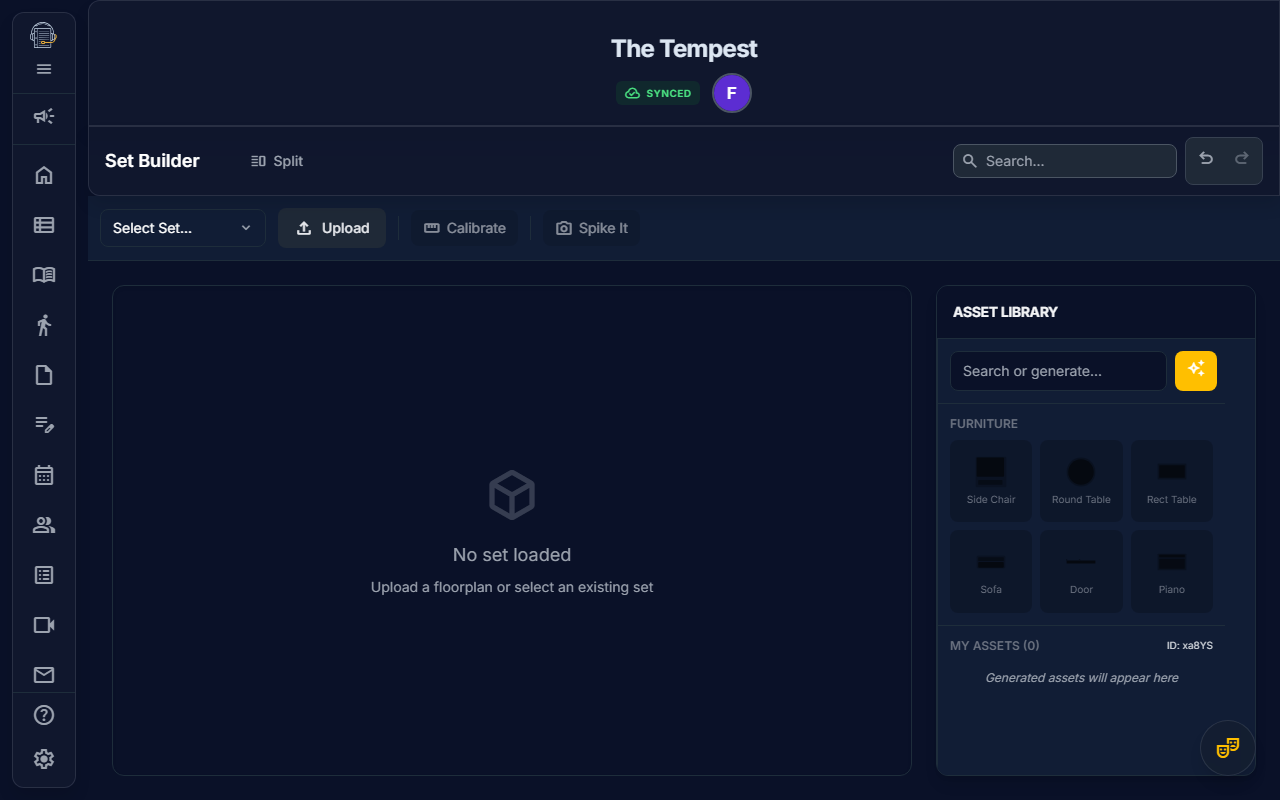
The Set Builder is a 2D canvas tool for designing stage layouts. It allows you to:
- Create stage layouts — Top-down view of your performance space
- Calibrate to real scale — Match your floorplan to actual dimensions
- Drag-and-drop assets — Furniture, platforms, and architectural elements
- Generate AI assets — Describe what you need and AI creates it
- Bake sets — Save configurations for reuse across scenes
Getting Started
Opening the Set Builder
- Navigate to Set Builder in the sidebar
- The canvas loads with your stage area
Understanding the Interface
| Area | Purpose |
|---|---|
| Canvas | Main stage view where you arrange elements |
| Asset Tray | Library of draggable furniture and set pieces |
| Toolbar | Tools for selection, drawing, calibration |
| Properties Panel | Edit selected element details |
Calibrating Your Stage
Calibration ensures your virtual stage matches real-world dimensions.
Step-by-Step Calibration
- Click "Calibrate" in the toolbar
- Import a floorplan (optional):
- Click "Upload Floorplan"
- Select your groundplan image (PNG, JPG, or PDF)
- The image appears as a background layer
- Draw a reference line:
- Click and drag across a known distance (e.g., proscenium width)
- A measurement line appears
- Enter the real measurement:
- In the popup, enter the actual distance (e.g., "40 feet")
- Click "Apply"
- All elements now scale correctly
Why Calibrate?
- AI-generated assets appear at correct size
- Distances on screen reflect actual spacing
- Blocking paths show realistic movement distances
- Print outputs have accurate scale indicators
Using the Asset Tray
Built-in Assets
The Asset Tray includes common set pieces:
- Furniture: Sofas, chairs, tables, beds
- Platforms: Riser, steps, stage blocks
- Architecture: Doors, windows, walls
- Props: Tables, desks, benches
Adding Assets to Stage
- Open Add Assets to show the asset tray
- Drag an asset by its drag handle, or click it to add it to the current set
- Drop it onto the canvas
- The asset appears at the drop location
- Resize using corner handles
- Rotate using the rotation handle
On touch screens, use the drag handle in the asset tile. The tray dismisses during the drag so you can place the item on the stage instead of fighting the sidebar.
Moving and Adjusting
- Click to select an element
- Drag to move it
- Corner handles to resize
- Rotation handle (top) to rotate
- Delete key to remove
Mobile and Tablet Layout
Set Builder uses a responsive toolbar and side tray. On smaller screens, long set names wrap into the toolbar, labels collapse behind icons, and the asset tray opens as a side panel so the canvas remains usable.
AI Asset Generation
Can't find what you need? Let AI create it.
Generating an Asset
- Click "Generate Asset" in the toolbar
- Describe what you need:
- "Blue Victorian sofa"
- "Art deco floor lamp"
- "Round dining table for six"
- Click "Generate"
- Wait 5-15 seconds for AI to create the SVG
- The asset appears in your personal asset library
- Drag it onto the stage
How AI Assets Work
- Generated as SVG icons (scalable vector graphics)
- Include real-world dimensions in metadata
- Automatically scale to match your calibration
- Saved to your project for reuse
Tips for Good Prompts
- Be specific: "Red velvet chaise lounge" > "couch"
- Include style: "Mid-century modern" or "Gothic"
- Mention size if unusual: "Child-sized desk"
Baking Sets
Baked sets are saved stage configurations that can be reused across scenes.
Saving a Set
- Arrange your stage elements
- Click "Bake Set" in the toolbar
- Enter a name (e.g., "Living Room - Act 2")
- Click Save
Loading a Saved Set
- Click "Load Set"
- Select from your saved configurations
- The stage updates with that layout
Linking Sets to Scenes
- Go to Show Structure
- Select a scene
- In scene properties, choose the associated set
- Now when you open that scene in Blocking, the set loads automatically
Floorplan Overlay
Import your theatre's actual groundplan as a reference.
Importing a Floorplan
- Click "Upload Floorplan" in the toolbar
- Select your image file
- The image appears behind your set elements
- Adjust opacity if needed
For cloud projects, uploaded floorplans, blocking backdrops, and baked spike images are stored as project set media instead of being embedded directly into the project shard. Deleting a set also schedules its set media for cleanup.
Working with the Overlay
- Trace over architectural features
- Calibrate using known distances on the plan
- Toggle visibility to show/hide the overlay
Keyboard Shortcuts
| Shortcut | Action |
|---|---|
Delete / Backspace | Delete selected element |
Ctrl + Z | Undo |
Ctrl + Shift + Z | Redo |
Ctrl + D | Duplicate selected |
Arrow Keys | Nudge selected element |
Shift + Arrow | Larger nudge |
Tips for Success
emoji_objects Calibrate early — Set up real-world scale before adding elements
emoji_objects Use baked sets — Save and reuse common configurations
emoji_objects Name sets clearly — "Act 2 Ballroom" beats "Set 3"
emoji_objects Link to scenes — Automatic loading saves time in blocking
emoji_objects Generate custom assets — AI fills gaps in the built-in library
Integration with Other Tools
| Tool | Integration |
|---|---|
| Blocking | Sets load automatically for linked scenes |
| Show Structure | Scenes can be assigned specific sets |
| Files | Floorplans can be stored in repository |
Video Tutorial
Video walkthrough: planned.
Related Guides
Last updated: January 2026